The Big Reason: Legends, Mantras, Battle Cries & Truth in Advertising
As
my grandmother Elizabeth aged, nearly all her statements became
mottoes or slogans or platitudes. “It’s a great life
if you don’t weaken,” she said right after we sang
her birthday song.
Granny was 100
and we commemorated the event with 100 candles that, by the time
she inhaled, formed a single immense flame on her cake. On that
day, her age, our enthusiasm and the physics of dentistry created
a momentous occasion.
When Elizabeth
let loose, exhaling mightily toward the 100 candles, she propelled
her upper dentures out of her mouth, over the table and onto the
floor, where they skidded across the room clanging against the
baseboard.
It is legend
in my family.
If
you can reduce a reason to live down to a simple phrase, you’ve
got yourself a motto. If you can shoot your teeth across the floor
with impeccable
timing, you become a mythological figure.
—
When
the Celts went to battle, they synchronized their war cries.
These unifying
hollers became known as “slogans.” Nowadays,  slogans
are phrases used repeatedly for promotion. The difference between
a motto and a slogan is, after all, only in the value you put
on the product. “Give me liberty or give me death” is
closer to “Just do it” than we’d like to think. slogans
are phrases used repeatedly for promotion. The difference between
a motto and a slogan is, after all, only in the value you put
on the product. “Give me liberty or give me death” is
closer to “Just do it” than we’d like to think.
The search for
the right slogan may take years, but when your own special battle
cry is heard you instinctively join in.
For
those who don’t yet have a slogan, perhaps their Celtic ancestors
screamed, “Still Looking” as they charged down grassy
slopes, arrows whizzing by. Those who refuse to have a slogan
might have had ancestors screaming,“So what.”
As
a youngster, I spent a good deal of time committing television
commercials
to memory. That was when cigarette advertisements were still on
TV. Size and length were a sales point. One popular brand kept
reminding me “It’s not how long you make it, it’s
how you make it long.” Truer, more inspirational words were
never spoken.
My competition
for TV viewing time was my mom. In her youth, she was fascinated
by Aimee Semple
McPherson — the prima Southern California evangelist
of the twenties. In that tradition, Mom watched Billy
Graham crusades and received blessing pacts from Oral
Roberts and the Abundant Life Choir.
Because
of this influence, I cut my teeth as a television cross-breed — part
consumer pagan and part broadcast evangelical Christian. I wondered
where the yellow went when I brushed my teeth with Pepsodent in
a metaphysical kind of way — and surrendered my body to the Wonder Bread
of salvation.
My
first ad campaign — or branding experience — occured
during ninth grade Social Studies where Mrs. Munroe, my teacher,
gave
the class two minutes to come up with a simply stated motivation
for living. 
“What
is your life’s motto?”
Ray Snider who sat next to me answered “Have fun.” The
class nodded in agreement. I was next.
“Strive,” I
said. “Even after you fail, always try to move ahead.”
I
was a earnest young man and figured that falling short and trying
harder was
standard operating procedure for the student-teacher environment,
but on the heals of “Have fun” I had pretty much harshed
the class buzz.
My primogenitors,
the Celts, could have helped then. The myth of Tristan
and Iseult was their gift to us — a formula for “words
to live by.”
Tristan,
the hero of this tale, spent his life in a struggle between
the “ideal” and
the “practical” — both of which were manifested
in women. Both women had the same name.
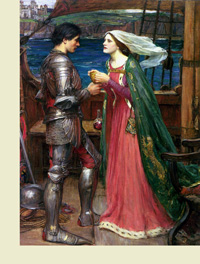 Tristan marries a “Practical” Iseult, but is emotionally and physically
driven by an “Ideal” Iseult. On his death bed he sends a secret
message across the sea to the “Ideal” with a request: If the “Ideal” still
loves him — still believes in him — she should send a ship with
white sails…if not, black sails. Tristan marries a “Practical” Iseult, but is emotionally and physically
driven by an “Ideal” Iseult. On his death bed he sends a secret
message across the sea to the “Ideal” with a request: If the “Ideal” still
loves him — still believes in him — she should send a ship with
white sails…if not, black sails.
The "Practical" Iseult,
however, learns of this secret plan. When Tristan’s dire
condition prevents him from seeing the ship arrive, he must rely
on her eyes to report. The ship appears decked in white, but when
Tristan asks, “What color are the sails?” the “Practical” replies “black.” Tristan
dies. End of story.
A
motto, then, is a light — or a sail. It is “the real thing.” It
is “true value.” It is bullshit. It is a plug; a soundbyte;
a quick fix. It manipulates us; lies to us; gives us identity.
This
is not the best of all possible worlds. This is the only possible
world — both
ideal and practical. In our gut we know it’s a great life
if we don’t weaken.
— Nathan
Callahan
|