Illiterature
for the Masses: California Recall Election 2003
Now
that the summer book season of easy reads, romance and adventure
novels and mysteries is coming to a close, it’s time to
consider serious non-fiction. In this category, Al Franken’s Lies
(And the Lying Liars Who Tell Them) still sits atop The
New York Times Bestseller List. However, a new entry, California’s The
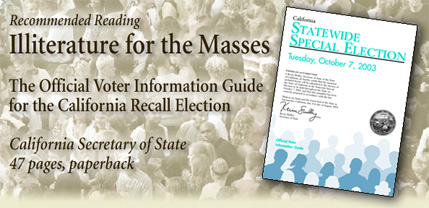
Official Voter Information Guide for the Recall Election is
beginning to look like this season’s most important new
work of non-fiction.
The Guide begins
with a brief section of expository chapters, but soon enters its
centerpiece, a unique realm of hope and idealism titled simply “Candidate
Statements: Governor.”
Brooke
Adams, a 25-year old sales executive from Orange County, opens “Statements” in
an uneasy rebellious tone, underplaying The Guide's gravity
with a slogan straight out of a community college textbook: “Lead,
follow or get out of the way.”
From there, The
Guide offers 104 separate, yet related works — an
intricate social patchwork of California and our country some
might say. Beware. The Guide’s self-deprecation
is fearless. There are glimpses of monsters and midgets, of
inspiration and disillusionment. At times breezy, at others
times garrulous, “Statements” is that rare moment
in literature that seems to burst with primal energy.
Curiously
hyphenated gubernatorial candidate Alex-St. James, proclaims
a strange dichotomy. “Once
an Aspirant Catholic Priest,” he says “I support life
from conception to the grave and the right to bear arms.”
Vik
S. Bawja, makes unique use of the surreal double entendre in
his sweet shattered
haiku-ish verse.“I am a recent immigrant like you,” he
says, “my 3 kids are native Californians, Kamal, and I thank
God for being in California.”
A
candidate sure to warm the hearts of misogynists statewide,
Warren Farrell
bellows, “My recent research has uncovered why children
raised by single dads do better than children raised by single
moms; why men now earn less then women for the same work; why
our sons now do worse in school, than our daughters.”
The
hypothetically downtrodden gender is skillfully sidestepped
by Rich Grosse, who
adds starpower to unmarraigables as he courts the lonely vote. “Single
adults are the Rodney Dangerfield of our society, “ he says. “’They
can’t get no respect’ I am the first candidate in
California history to campaign on a Fairness for Singles Platform.”
All is not simply
affairs of state for The Guide. As Kevin Richter reveals,
there may be a minimalist metaphysical edge to life in Sacramento.
Richter sums up his qualifications in two simple words: “I
breathe.”
Inhale,
indeed. B.E. Smith gives insight not usually found in state
sponsored
readings. “I spent two years in federal prison,” he
says, “because I grew medical marijuana….” He
hopes to free all current prisoners of the drug war.
Midway through, The
Guide's carefully crafted mood shifts when Trek Thunder
Kelly journeys down a frightfully obscure side path. “Dear
Voters, Please vote for me, thus breaking the Seventh Seal and
incurring Armageddon.”
But
Kelly’s
end times proclamation is soon thoughtfully tempered by Diane
Beall Templin’s religious sentiments. “May the Lord
give you the Wisdom of Solomon as you vote,’ she says. “I
pray that the Wonderful Counselor, the Mighty God, will guide
me in all decisions, especially in selecting the best and brightest
trusted servants to resolve the budget crises and heal our land.
2 Chronicles 7:14.”
Bill
Prady, on the other hand “is an award-winning television comedy
writer and producer who will bring the skills he’s learned
creating sitcom episodes to Sacramento. If elected, he pledges
to solve all the state’s problems in twenty-two minutes
and forty-four seconds with two commercial breaks and a hug at
the end.”
The mesh of
opposing directions and literary techniques in The Guide is
stunning. Yet, somehow, it holds together as a cohesive volume.
David
Ronald Sams' short choppy style is an exercise in thought-hopping: “There’s
too much violence in the media. I’ve won nine Emmy awards.
This campaign should be about one issue: Balancing the budget.
We must think 'out of the box.' For example, I would offer naming
rights to our freeways.”
Kurt
E. “Tachikaze” Rightmyer
foreshadows his predicted tenure by explaining his curious middle
name. "The name Tachikaze stands for ‘wind from a sword
stroke,’” he says “As the leading middleweight
of the California State Sumo Series and a serious, well-educated,
non-partisan candidate for governor, I will attack the 800-lb.
gorilla of big government…”
Whether or not
the California Recall takes place on October 7, 2003, The
Guide will remain an important artifact in American literary,
as well as regional, history. Remarkably, California’s registered
voters received this extremely collectable work of illiterature
for free, courtesy of the state. For the moment, the rest of the
world can bid for copies on eBay.
The Official Voter Information Guide for the California
Recall Election is a milestone publication, breaking
through the traditionally over-marketed state of American
politics. Its honesty will make you cringe. Yet, by declarative
magic, the guide illuminates the world through the stories
it tells.
At
the conclusion of this masterful new postmodern work, we are
left to reflect
on candidate Ivan A. Hall’s one line entry, directed not
only at the state of California, its gubernatorial candidates,
and American culture, but also at civilization itself.
“What’s
it all about?” he asks.
— Nathan
Callahan, September 18, 2003
|