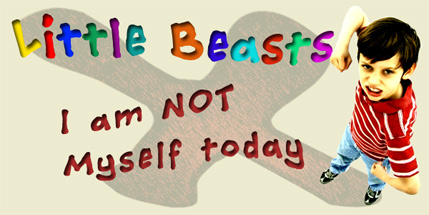
Little Beasts: I an Not Myself Today
I am not myself today. It isn’t because I am awash in all
variety of ruination — that my 17 year-old dog, Luna, died
in my arms last Wednesday or that my 100 year-old senile grandmother — of
whom I am the only grandchild — called me Herman (her long
deceased brother’s name), and told me to milk the cows (I
consented, hundreds of miles from the nearest bovine utter). And
it isn’t because Saturday, just after the earthquake, I
crashed a 1,600 name data base or that my career, a phenomena
that was once described as “rocketing,” has blown
an O ring. Or even because the latter circumstance prompted several
of my prozac-addled friends to elevate my anxiety with cheery
smiles and assurances that I am in the throes of a mid-life crisis
at the super nova stage, and should seek therapy, pills, or both.
These
things are tenuous. Like Casablanca’s Rick I recognize
a hill of beans when I see one. Careers come and go, as do mental
states
and temblors. What is the focus of my disquietude, what was the
crux of my distress, what is bothering me more than anything else
is Dylan.
Dylan, an eleven-year-old,
who was named in a folk-rock fit of passion is, simply put, a
spoiled little puke. He creates messes that he has no intention
of cleaning up. He defies his parents who have developed the New
Age, brain-heavy, limp-spine approach to child-rearing. He purposely
torments his seniors with selfish and outlandish requests. He
laughs in their faces when they grovel to fulfill his wishes.
Dylan rules
and he knows it. And the reason Dylan rules is not because he
is more intelligent or stronger, or has more money, power, or
leverage. The reason Dylan rules is because he is a child.
David,
his father, is genteel… middle-aged… intellectual. One of the
goals of his life — a goal he shares with his wife Melissa— is
to create the perfect human. These altruistic Dr. Frankensteins,
both professors at the University of California, have substantial
incomes, and are admired community-wide as hard-working, civic-minded
and perceptive. But they live in a black hole when it comes to
the relationship they have with their son, Dylan.
Personally,
I never cared for the little beast, but my niece likes to play
with him, so I endure. Today, however, is different. I've changed.
In this hot and shaky terrain I'm prepared to take my stand. Inspired
by all things dark and dangerous I feel ennobled. I feel like
an adult.
Today,
after a very enjoyable two-hour conversation — Offspring and Sugar
Ray, Mirror Ball and Stan Kenton, Van and Jim Morrison; acid house
and acid rain; John Wayne and Gacey. David and I stroll into the
living room. He gently tells Dylan that it is time to stop playing — time
to go home for dinner. Dylan, however, who is playing at the X-box,
objects. He has another plan…and a means to accomplish it.
First
there is the body language — the disgruntled exhalation
of air, the tossing of arms to his side; next, the fierce look,
eye-to-eye
with his father, lips curling back.
Then, out it
comes.
“No,” he
says. “No” in a seditious eleven year-old brat way. “No” like
I’ve heard him say hundreds of times. It's a “No” that
I feel in the pit of my stomach.
After punctuating
his defiant glare, Dylan turns around, completely ignoring his
father, and continues play.
With a shrug of his shoulders, David laughs nervously and gives
me the ironic “What
can you do?” sideways look.
A spark arcs
across uncharted territory in my gray matter. I sing the body
electric. I am awake with a revelation 10 times more absolute
than post-migrane clarity.
“Go home,
Dylan,” I say firmly.
“Why?” he
barks back.
The
room is still — a perfect moment.
“Because,” I
say, “It’s over.”
And it is. David
and Dylan leave.
I've
been told by David that Dylan is in the midst of developing
his personality.
That soon his persona will be locked in place. I am told that
if something unnatural occurs during his development — before
that blessed point in his life that freezes his personality (a
point that, according to lore, I passed decades ago) — his
only escape will be years of psychiatric treatment.
Well-respected,
academic, child-rearing authorities address this doctrine of confined
development in Zen all-knowing, all-seeing seriousness. They ordain
the religion of a life lived looking backwards — always
defining potential with recollection.
Give Dylan lots
of space, room to grow. His bad behavior should be ignored, and
praise should be lavished on him. If all goes well he will grow
up uncluttered, non-dysfunctional, a model of creative prowess.
If all goes well, he will look back on his childhood as the wellspring
of all he is and all he will become.
But
David’s
wellspring is now and he is being cheated by Dylan. Outside of
work, everything he does, every place he goes is based on whether
or not Dylan can go there too. There are little league games and
swim meets and guitar lessons and parenting classes and the latest
animated film classic and math tutors and drawing classes ad
infinitum.
Like millions
of other well-meaning young upwardly-mobile urban professional
do-gooders David is afraid to be disliked by his children. He's
afraid that in that moment of confrontation and denial the child's
innocence will be lost. And so it should be.
To
be without innocence is to want to be everything without ceasing
to be ourselves — a
mystic secret, worth keeping. One that I won’t waste on
the little beasts.
— Nathan
Callahan, June 5, 1994
|