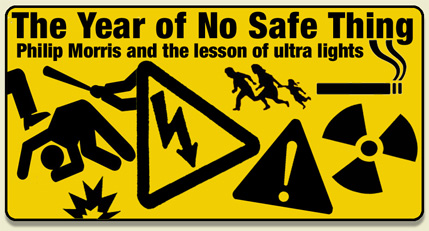
The Year of No Safe Thing: Philip Morris and the Lesson of Ultra lights
2003
should be a great year for my phobias.
If
thoughts of Ricin smeared on a Disneyland turnstile, shoulder
launched stinger missiles aimed at flights out of John Wayne
Airport and snipers picking off patrons at Fashion
Island aren't
enough to stimulate my phobic nerve, there's always the fear
nugget of federal agents intercepting my email after detecting
the terrorist code words "dope" and "Bush."
But
in case these outbreaks of acute information awareness don't
fill me with enough existential dread, I can always replay the
day last week when I found out about Philip Morris's emblematic
if not historic announcement. I'll repeat it for those of you
peering though a different code red news hole.
"There
is no such thing as a safe cigarette."
I
found out about this breach in our national security in a decidedly
lo-tech way. It wasn't on the internet, TV or radio, but rather
in the gravel parking lot behind the Gypsy
Den when my friend Kitty cracked a pack of Benson & Hedges.
Fluttering to the ground as I stood nearby was a parchment
certificate with an embossed Philip Morris logo. Kitty picked
it up.
"There
is no such thing as a safe cigarette," she read aloud.
"The
tar and nicotine yield numbers are not meant to communicate the
amount of tar or nicotine actually inhaled by any smoker, as individuals
do not smoke like the machine used in the government test method."
Kitty's
eyes widened as she tried to suppress a nervous mechanical laugh.
"You
should not assume," Kitty and the warning continued, "that
cigarette brands using descriptors like 'Ultra Light', 'Light',
'Medium' or 'Mild' are less harmful than 'full flavor' cigarette
brands or that smoking such cigarette brands will help you quit
smoking."
"Thank
God for that," Kitty quipped and fired one up.
"If
you are concerned about the health effects of smoking," the
warning from Phillip Morris concluded, "you should quit."
As
we marveled at Morris's pragmatic punchline, a fear twisted
through me not unlike the spinal twinge induced in the movie "Marathon
Man" when Sir Lawrence Olivier's character asks "Is
it safe?" His question is an award-winning anxiety disorder
moment because the answer is clear. "No it is not.
For
better or worse, most of the entire civilized world reckoned
years ago that there is no such thing as a safe cigarette or
for that matter a safe car, boat, train, cup of coffee, hair
dye, visit to the dentist, electric socket, Christmas tree,
dog, camping trip, peanut butter sandwich or appointment to
the Supreme Court — just to name a few.
Safety,
after all, is a relative thing. Knotts Berry Farm's Perilous
Plunge was a "safe" ride, until a thrill seeker with
a 58-inch waist squirted out of the lap bar, and perilously
plunged 115 feet to her death. The World Trade Center was a "safe" building
complex… until it became a doorway to heaven for a fucked-up
group of true believers filled with passionate intensity.
I
would even go so far as to say that if all things were safe,
we'd have at lot less use for religion. But they're not and
we don't.
Which
brings me back to Philip Morris. I envision the day, perhaps
within my lifetime — perhaps later this year — when
a little parchment warning note comes fluttering out of everything — oak
trees, ceramic surfing monkeys, waterfalls, solar eclipses,
fountain pens, valentines and newborns. On it would be the all-encompassing
safety disclaimer: "There is no such thing as a safe life."
— Nathan
Callahan, February 14, 2003
|