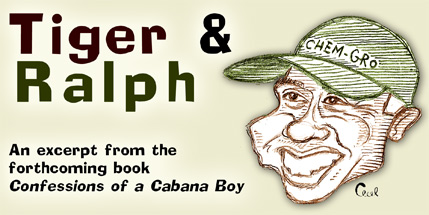
Tiger
Woods and Ralph Nader
"Subvert
from within,” Ralph Nader says. “And you, Tiger,
have definitely got the ‘within’ part covered. Golf
and grass go together. Sam Snead, the 1952 Masters Golf Tournament
winner, advertised for Toro lawn mowers. Jack Nicklaus, Arnold
Palmer and Bobby Nichols all hawked lawncare paraphernalia.
It’s a ritual that reassures middle-class American males
they can find their balls in a well-trimmed lawn. Now it’s
your turn, but with a different spin. You can take down a corporate
polluter and be the ultimate adbuster. The contract is sitting
right here on the coffee table. Donde esta tus huevos? When
is the world going to hear ‘This is Tiger Woods for Chemgro?’”
Tiger is pissed. Ralph won’t relent. That’s
when I walk in with two
iced Stolis. Let me explain.
For
the last five years, I’ve been a cabana boy. I work at “del
Nada” which isn’t the resort's name, it's just what
the hired help call it. The truth is, del Nada doesn’t
have a name. To the clientele it’s simply known as “The
Club” — the world’s most exclusive and confidential
playground. You won’t find “The Club” reviewed
in “Travel” magazine or on Google. Even its guests
are reluctant to talk it. Exclusive with a capitol “E,” del
Nada is where “patrons of pleasure” do whatever
they want in complete utter unapproachable privacy — provided
they could throw down $20,000 a night and get social clearance.
But
that’s all going to stop here in the summer of 2015. I’m
ending my tenure at del Nada and, after months of soul-searching,
I’ve decided to tell all. The result is what you have
in your hands — the most scandalous book ever written.
But these “confessions” are more than unbearably shocking exposés
or intimate secrets of the rich and famous. They contain lessons for all of
us — about relationships, about life, and about making a small fortune
capitalizing on the idiosyncrasies of the celebrated.
Saddam
Hussein, Bono, Arianna Huffington, Donald Rumsfeld, Ann Coulter,
David Lynch, Martha Stewart and Marlon Brando (they had adjoining
cabins) have all been patrons of mine. So when I walk in on
a bitch fight between the 10-time U.S. Open Champion and the
man who brought us “Unsafe at Any Speed,” I don’t
ask questions. Let’s get back to the action.
“I
never understood your obsession with clubs, but a real golfer
plugs lawn care.” Nader says. “Buicks and Nikes
don’t count.”
Tiger
is ferociously brushing his Colgate kid smile as he paces. This
seems to please Ralph — which is one of the reasons I
campaigned for him way back in 2000. Nader is uncompromising
in an argument. He’s never satisfied to simply insert
the knife: He can only achieve pleasure while twisting the blade.
If you want to know why Democrats stopped acting like Republicans,
just blame Ralph and Nathan.
“You
wouldn’t be living this upscale lifestyle with me if it
wasn’t for Buick and Nike,” Tiger says. “What
do you want anyway? Every golf course in the world to be Al
Ahmadi?”
For
those unfamiliar with Middle Eastern eccentricities, Al
Ahmadi is the world’s strangest golf course. It has
no grass. A par 70, 6299 yard sand trap located in Kuwait City,
Al Ahmadi requires players to caddy a small piece of artificial
turf. Wherever their ball lies on the fairway, they transfer
it to the patch and swing away. The course has no greens. Instead,
the compressed dirt around the hole is called “the brown.” I’m
told, through the cabana boy grapevine, that they play true.
“All
golf courses should be as dry and chemical free as Al Ahmedi,” Ralph
says. “What’s the point of a lawn 50 yards from
the tee when you’re driving the ball 300 yards. It’s
a waste — hundreds of miles of godawful green turf sucking
up water like a Shop-Vac.
“So
move to Kuwait, weasel lips. And sober up while you’re
at it. I’m not going to be one of your Raiders,” Tiger,
toothpaste foam on the corners of his mouth, rabidly barks.
Nader growls and throws back a shot. “No kidding. You plugged Nike and
their global sweatshops. Remember? Your mother was Thai. Did you ever wonder
how many of her relatives made slave wages sewing on the swoosh? It’s
time you made up for that. When I ran for President, there were 46.5 million
acres of lawn in America. If you ask me, that’s about 40 million acres
too many. Show some courage. Sign the dotted line. Pitch lawn care products.
Then hold a press conference and blast the biotech business. End your career
with a bang. Sabotage Chemgro."
By
now, I’m sure you’re wondering why Mr. Nader is
focusing his efforts on lawn care. Was he forced to mow the
lawn as a child? Is his octogenarian medication affecting his
mind? Does he believe fairways have something to do with grassroots
politics? Who knows? My job is to focus on soaking up the vodka
spill as ordered.
But
not for long.
Nader
stumbles over to me and offers to help. I plead “no.”
“What
do you think about our discussion?” he asks me.
Off
the record, I was once allergic to grass. I’d puff up
like a blowfish if I inhaled the stuff. My eyes would swell
shut — tears streaming out, Niagra-like. Now, thanks to
the miracle of modern pharmaceuticals, I can visit a freshly
mowed cemetery or spark a fatty whenever I please.
“I
wouldn’t want to taint the vote,” I say.
“Why
not?” Nader replies. “I know you’re on my
side. As a service worker here at the Club, aren’t you
repulsed by the class divisions inherent in golf? Of course,
grass in and of itself is not evil. It’s when grass is
organized for no just or good purpose that it becomes insolated
. . . insla . . . insla… insidious.”
The
fresh Stoli is already taking its toll.
Unorganized
or not, grass is something I know far too much about. I owe
this to my father — a Professor of Urban Agriculture at
Mexico City University. It takes every bit of my del Nada training
to keep from joining in the conversation with Tiger and Ralph,
letting them know that Mayans, Aztecs, ancient Persians and
pre-colonial American Indians meditated in natural meadows;
or that a Japanese do-it-yourself gardening book from 1156 AD
featured techniques for sodding with low-growing zoysia grass;
or that in the Middle Ages, grassy fields surrounded castles
to serve a dual purpose — a sneak-attack buffer-zone and
a cow pasture.
Nader,
in the meantime, has more congratulatory things on his mind.
“Happy
birthday to me.
Happy birthday to me.
Happy birthday dear consumer advocate.
Happy birthday to me.”
Plopping
a party hat on his head, he mumbles a few more improvised verses
of “Happy Birthday” to himself and climbs back on
his soapbox.
“I
bet you didn’t know that the renowned economist, the world’s
earliest cool-hunter, Thorstein
Veblen was the first to observed what I call the Tyranny
of Organized Grass.”
That
does it. I can’t help myself anymore. Dad was a student
of Veblen. I begin quoting from his 1899 classic “The
Theory of the Leisure Class,” bedtime reading in my family.
“’The
close-cropped lawn is beautiful in the eyes of a people whose
inherited bent it is to readily find pleasure in contemplating
a well-preserved pasture or grazing land,’” I say.
“Excellent,” Nader
responds. “I’m very impressed. But let me interpret
for you, Tiger. Lawns were beautiful, according to Veblen, because
they remind rich folk of their heritage as cow owners.”
“Screw
you,” says Tiger.
“Make
me,” says Nader.
Veblen
issues from my mouth again. “’To the average popular
apprehension, a herd of cattle so pointedly suggests thrift
and usefulness that their presence in the public pleasure ground
would be intolerably cheap.’”
Nader
cocks his head and stares, trying to make sense of Veblen via
room service.
“In
other words,” he condescending slurs, “cows are
lower class, especially in a yard.”
And
so it happened that Ralph Nader and a low-life cabana boy named
Nathan Callahan turned an afternoon with the world’s best
golfer into a discussion of lawns as a division of classes.
“It’s
worth noting, however, that according to Veblen, deer ‘are
not vulgarly lucrative.’”
“In
other words,” Ralph finishes my thought, “deer are
trendy. That’s why antlered replicas and other useless
stone knick-knacks — frogs, bunnies, gnomes and lawn jockeys
are used as lawn ornaments. They’re the talismans of upper-class
cattle-free discretion. ‘It is the shear impracticality
of mowed grass that gives it stature.’”
“Can
you just let it go?” Tiger says. “It’s your
birthday, Mr. Public Citizen. Relax and be happy.”
Ralph,
Stoli in one hand, nine iron in the other, has other plans.
“No.
No. No. This is the part you’ll love, Tiger. In 1906,
the US Golf Association conspired with the US Department of
Agriculture to create a super turf — something crisp,
clean and even. That was the turning point in lawn politics.
That’s where your ridiculous sport comes in. With the
Feds on their side, golfers were ecstatic. The American public,
always easily impressed by white men swinging clubs, followed
enthusiastically along.”
Tiger,
who has worn the toothbrush to a splay of bristles, spits hard
into the sink splashing the mirror with white diluted paste,
but does not reply.
Nader,
surprisingly agile at 80, takes this as a sign to begin bounding
around the room tossing his towel back and forth like a skirt,
his speech in the cadence of a schoolyard tattletale.
“Tiger.
Tiger. Burning Bright.
In the golf cart of the night.
What immortal hand or eye
Dare frame thy backswing symmetry?
“That’s
why only you, Tiger Woods, can revolutionize the world of golf.
Just sign this advertising contract with Chemgro. Then blast
the corporate polluters with an anti-grass proclamation. For
once in your life, be an activist.”
“Will
you just shut up,” Tiger says.
“Hi,
this is Tiger Woods for Chemgro” Ralph says impressionistically. “As
the world’s most humble golfer, you can take it from me:
There are better things to do with your time than hitting a
ball into a hole.”
With
that, a Nike Tiger Woods signature golf ball sails out of the
bathroom and bounces off the side of Nader’s head. At
first he appears to feel nothing. Then, half dancing, half reeling,
he crosses the room and sits slowly on the sofa.
“Owwww,” he
says.
Tiger
brings a washcloth with some ice and places the cold pack lopsidedly
on the birthday boy’s imaginary bruise.
“Nice
shot,” Nader says.
Tiger
smiles, rolls his eyes, signs the dotted line and hands the
Chemgro contract to Nader.
“Happy
Birthday, Ralphy. ‘So long as men can breathe, or eyes
can see, so long lives this, and this gives life to thee.’”
“Thank
you, Tiger.”
On
his knees, the situation finally under control, the soon-to-be
adbuster applies kisses to Ralph’s receding hairline.
“Thank
YOU, gentlemen,” I say and gently shut the door behind
me.
— Nathan Callahan,
October 13, 2003
|