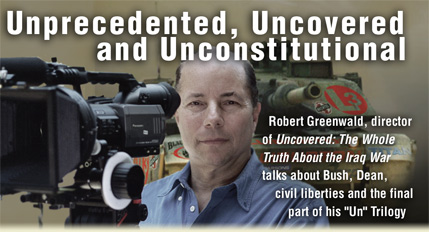
Unprecedented,
Uncovered and Unconstitutional: Robert Greenwald, Iraq
W hile
Karl Rove is green lighting the Bush 2004 presidential campaign — a
soft-focus Morning
in America montage that edits out four years of scandal,
fear-mongering and war — Robert Greenwald is busy creating
a trilogy documenting the Bush administration’s first
and, hopefully, last term.
Greenwald
produced part one, Unprecedented:
The 2000 Presidential Election, in 2002. It’s
a disturbing look at the Florida election — a twisted
undemocratic process tainted by irregularities, electoral
injustices, and voter purges in a state governed by the winning
candidate's brother.
Next,
Greenwald produced and directed Uncovered:
The Whole Truth About the Iraq War. Told through more
than 20 interviews with experts totaling over 300 years of
government experience, Uncovered exposes the distortion
of intelligence that led the U.S. into its current quagmire
in the Middle East.
Now,
Greenwald is working on part three of the trilogy. Mike Kaspar
and I spoke with him on our KUCI radio show, Weekly
Signals, about his work and the upcoming presidential
election.
Bush
has been called “the worst president in history.” Isn’t
it disheartening to work on a project about his life?
"There’s
at least one hopeful thing that has happened because of Bush:
Politics has come back into the center of people’s lives.
In my profession, making films, I’ve never seen a greater
concern, involvement and discussion on an ongoing basis. That
talk is usually about what movie is getting green lit. Now,
there’s a tremendous discussion about politics — who’s
going to be the candidate, campaign issues and the state of
the country. I see tremendous hope in that because in survey
after survey Bush is shown to be out of touch on the issues.
His is a radical right agenda not connected to the way that
the majority of Americans feel. And if we all can get off our
butts and work hard enough, there will be a difference in 2004."
You
released Uncovered at the end of 2003 in a unique
way. Over 2,600 people from all over the country held DVD
premier house parties. What’s happening with the film
now and do you think it’s having any political effect?
"The
film has an unsettling effect on people who feel that the war
was the right thing to do based on how dangerous they were told
Saddam Hussein was. To them it was profoundly unsettling because
they weren't given the right information by their government.
"There
is no doubt that Hussein was a terrible danger to his own people,
but the notion that he was a danger to the rest of the world
is nonsense."
Will
a change of presidents bring about a quick reversal of our
foreign policy?
"Ambassador
Joseph Wilson, who I have enormous respect for, said something
that continues to trouble me. He said that this is not going
to take a couple of years to rectify. There’s been a lot
of damage to the our country’s reputation, starting with
where we were on 911 when ninety percent of the world supported
us to now, when ninety percent is against us. This is going
to be a long-term reclamation project. So, if there’s
a change in the presidency in 2004, whoever it is will have
to work long and hard. It will be difficult to get it turned
around."
Who
among the Democratic candidates is best suited for the job?
"I
think there are many people better suited for the job than Bush — and
this is just my personal opinion — or Lieberman, who I
would not support. But otherwise I think there are many capable
candidates and hopefully, sooner rather than later, there will
be one. Then, the country can have a real debate and see the
alternatives to Bush’s policies."
Lately,
some members of the Democratic Party have spent more time
criticizing the frontrunner, Howard Dean, then criticizing
Bush. What’s your take on the bickering?
"I’m
almost embarrassed by the way several of these candidates are
dragging themselves into the gutter, running a campaign that’s
anti-Dean.
"No
one is going to vote for anybody because they’re anti-Dean.
No one is going to vote for a Democrat because he’s busy
attacking another Democrat.
"It’s
nonsense and we’re seeing that the candidates who are
leading the attacks are just falling further and further behind
in the polls. If they agree that the current president is a
serious threat to many of the things that Americans believe
in, then I would hope that they would campaign on a different
level and not just campaign on what looks like pure ambition."
What
is store for 2004?
"Uncovered is
the second part of a trilogy. The first part was Unprecedented, and
the third, that we’re working on right now, is called Unconstitutional:
Civil Liberties After 911. We will have it out by May or
June.
"There
are heart wrenching, painful stories about people whose civil
liberties are being abused every day in the name of the war
on terrorism. Unconstitutional will be told partly
with interviews with experts, as we did in Uncovered. But
its primarily going to be a personal emotional narrative. We
want to bring home to people that their civil liberties are
not just abstract concepts. Civil liberties effect how we live
our lives. Even a lot of conservatives agree that we’re
seeing an enormous destruction of those liberties right now.
Again, it’s an issue that shows Americans are not supportive
of the Bush administration."
Will
John Ashcroft have a starring role in the new film?
"We’ll
take a hard look at the Patriot Act and John Ashcroft being
the champion of that. But it’s not just one guy. It’s
a law that was passed in the middle of the night, not read by
many legislators, just forced through at a time when they were
literally told that if they didn't sign it then, they’re
going to be to blame when
something bad happens in this country.
Today, there’s evidence that the Patriot Act has been
completely ineffective and a complete waste of resources."
Are
you working on any other similar film projects for 2004?
"I’m
also working with the AFL-CIO in creating a 15-minute piece
about Bush’s war on jobs and the loss of jobs. Hopefully,
that will also help in connecting to another constituency."
How
can progressives help change the national agenda?
"Historically,
issues effect the candidates. But there’s a tendency for
progressives and liberals to say “Where is our knight
in shining armor?” I say it’s the opposite. If you
look at civil rights, or the women’s movement or the environmental
movement — all of them started at the grass roots level.
Then, the politicians followed. It’s their job to follow.
So, whatever is the strongest issue — environment, jobs,
health care — I urge you passionately to get involved
with it to make it more forceful. Then, believe me, whoever
the candidates are, they will be responsive."
— Nathan Callahan,
January 7, 2004
|